
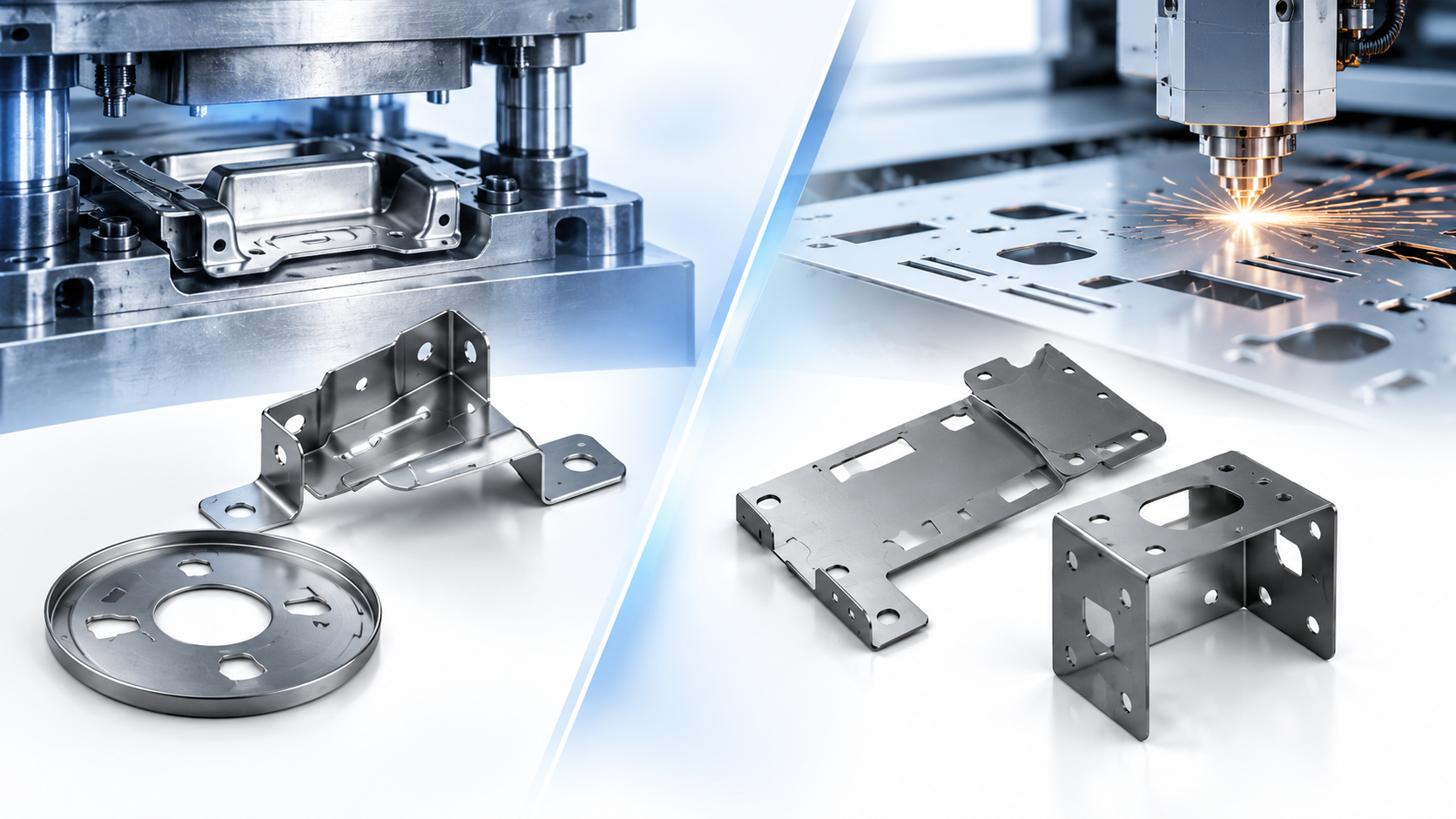
A sheet metal part can take more than one route from an engineering drawing to a finished component. Two common options are metal stamping and metal fabrication. Both can produce precision parts, but they differ in tooling requirements, production methods, flexibility, and lead times.
For engineers, product developers, and purchasing teams, choosing between these processes involves more than comparing the cost per part. Production volume, part geometry, material, design maturity, and delivery schedules all influence the decision.
Manufacturers that offer both processes may also have an advantage when timing matters: fabrication can provide a way to produce suitable parts while dedicated stamping tooling is being developed.
Metal Stamping vs. Metal Fabrication at a Glance
| Consideration | Metal Stamping | Metal Fabrication |
| Manufacturing method | A press and die cut and form metal | Laser cutting, punching, bending, forming, and joining |
| Tooling | Dedicated dies are typically required | Programmable equipment often avoids dedicated stamping dies |
| Production applications | Prototypes, pilot builds, and medium- to high-volume production | Samples, prototypes, pilot builds, and low- to medium-volume production |
| Initial investment | Higher when dedicated tooling is required | Generally lower tooling investment |
| Production efficiency | Can be highly efficient once tooling is established | Depends on machine time, labor, and the number of operations |
| Design changes | May require tooling modifications | Often accommodated through programming changes |
| Lead-time considerations | Tool design, construction, and validation take time | Suitable parts may be produced without waiting for a stamping die |
Neither process is universally better. The right choice depends on the part, production requirements, and expected product lifecycle.
How Metal Stamping Works
Metal stamping uses a mechanical or hydraulic press and specialized dies to cut and form sheet metal or metal strip. Depending on the design, operations can include blanking, punching, bending, drawing, and forming.
Progressive dies perform multiple operations at successive stations as material moves through the tooling. Compound and secondary tooling provide other ways to manufacture parts, depending on their geometry and requirements.
Once the tooling has been developed and the process validated, stamping can produce consistent components at high production rates. The initial investment in tooling can be distributed across the production run, potentially making stamping economical for programs with sustained demand.
Press capacity also matters. The required tonnage depends on the material, thickness, part geometry, and operations involved. Larger or more complex components may require higher-capacity presses and suitable tooling.
Larsen Manufacturing offers more than 35 stamping presses across its manufacturing locations, with press capacities ranging from 25 to 1,000 tons. The stamping operation also offers press bed sizes up to 144″ × 72″ and speeds of up to 100 strokes per minute.
These capabilities allow the appropriate equipment and tooling to be considered according to the component’s size, design, and production requirements.
Larsen’s stamping services include progressive tooling, compound and secondary tooling, in-die hardware insertion, in-die tapping, and in-die labeling.
How Metal Fabrication Works
Metal fabrication combines several processes to transform sheet metal into finished parts and assemblies.
A typical component might begin as a flat sheet. A laser cuts the required profile, a turret punch press creates holes or other features, and a press brake forms the material into the required shape. Additional operations, such as welding, hardware insertion, machining, finishing, and assembly, may follow.
Because much of the equipment is programmable, manufacturers can move between different part designs without developing a dedicated stamping die for each component. This flexibility is particularly useful for prototypes, design changes, and lower-volume production.
Larsen’s fabrication operation uses Amada sheet metal fabrication equipment, including two 4,000-watt lasers with nitrogen generation, two 33-ton high-speed turret presses, and eight 88-ton electric/hydraulic press brakes, as listed on its website. The company also offers MIG/TIG welding, spot welding, hardware insertion, machining, finishing, and assembly.
Its fabrication capabilities support samples, prototypes, pilot builds, and low- to medium-volume production.
These processes can be combined to produce a wide range of components. The appropriate equipment and process sequence depend on the material, geometry, tolerances, and production requirements.
What Determines the Right Process?
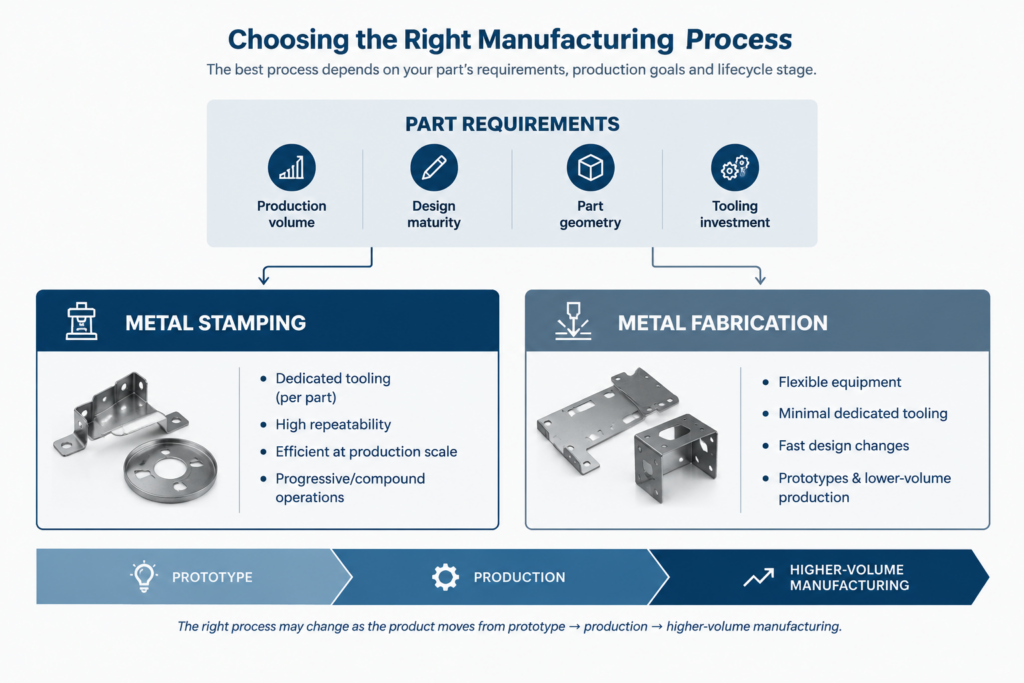
Production volume and cost
Production volume is an important factor when comparing stamping and fabrication.
Stamping requires investment in die design, construction, testing, and maintenance. That investment may be justified when enough parts will be produced over the tooling’s useful life.
Fabrication generally requires less dedicated tooling, which can make it attractive for prototypes and smaller production runs. However, each cutting, bending, welding, or other operation adds to production time and cost. As quantities increase, stamping may become worth evaluating.
There is no universal production-volume threshold at which stamping becomes economical. The crossover point depends on tooling costs, part complexity, material, cycle time, secondary operations, and expected lifetime demand.
Part geometry and material
The shape of a component can influence process selection as much as its production quantity.
A component with multiple formed features may be well suited to a dedicated stamping die. Another part may require a combination of laser cutting, bending, and welding that makes fabrication more practical.
Material type and thickness also matter. Steel, stainless steel, aluminum, and other metals behave differently during cutting and forming. Equipment, tooling, and process parameters must be selected accordingly.
Both stamping and fabrication can produce precision parts, but achievable tolerances depend on the material, geometry, tooling, equipment, and process controls.
Design maturity
When a design is still changing, committing to production tooling can introduce unnecessary cost and delay. A change to a hole location, bend, or formed feature may require a die modification and additional testing.
Fabrication offers more flexibility during this stage because suitable equipment can often be reprogrammed to accommodate design revisions.
Once the design has been validated and production requirements are established, stamping can be evaluated for repeat production.
Managing Stamping Tool Lead Times With Fabrication
One challenge in metal stamping is the time required to develop production tooling. A die must be designed, manufactured, installed, tested, and validated before it can support the intended production process.
For a customer facing a tight launch schedule, this can create a gap between when parts are needed and when stamping production is ready.
Fabrication can help bridge that gap when the part is suitable for both processes.
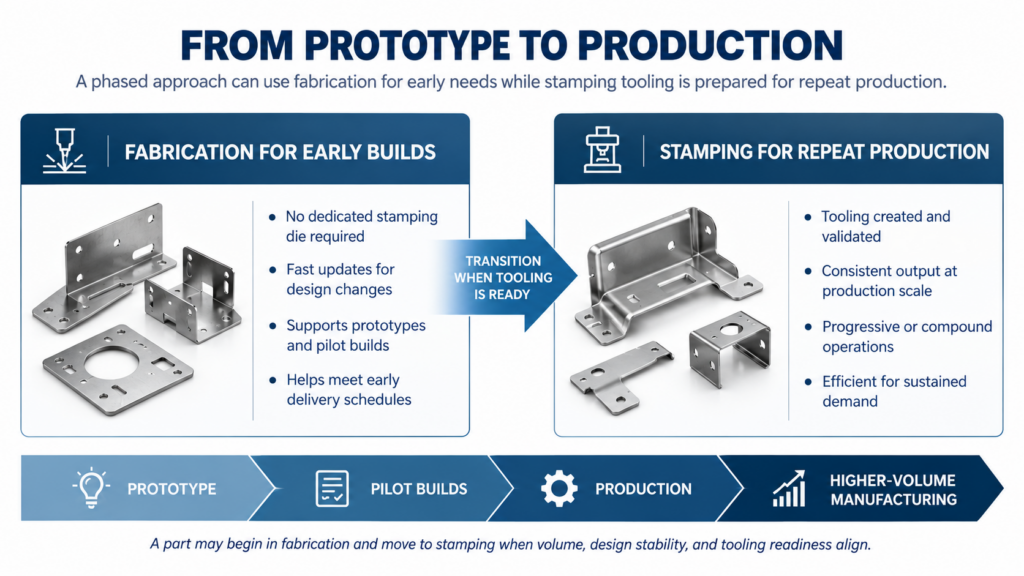
Consider a component that will ultimately be manufactured using a progressive die. While the die is being built and tested, a manufacturer may be able to produce an initial quantity using laser cutting and press brake forming. These parts could support prototype testing, pilot builds, assembly trials, or certain early production requirements.
Once the stamping tool is ready and validated, production can transition to stamping if it offers the right combination of output, consistency, and cost.
This approach may help customers maintain development schedules or prepare for a product launch without waiting for the entire tooling process to finish before receiving any parts.
The feasibility depends on the component’s geometry, material, tolerances, quantity, and intended use. Fabricated parts must meet the applicable engineering and quality requirements; they are not automatically interchangeable with stamped parts in every application.
Because Larsen Manufacturing offers both stamping and fabrication, customers can discuss whether this staged approach is practical for their parts and delivery schedules.
Real-World Example: On-Time Launches for Bay Area Energy Customers
Larsen has applied this approach for energy customers in the San Francisco Bay Area, including programs in battery energy storage and solar energy. Each faced an aggressive launch schedule, and their products required a mix of formed brackets, enclosures, panels, and structural components. Waiting for every production die to be built and validated would have put those launch dates at risk.
Instead of relying on a single process, Larsen combined both. Its fabrication team produced the initial parts using laser cutting, turret punching, press brake forming, and welding, with no dedicated stamping tooling required. That allowed the customers to validate their designs, run pilot builds, and start production on schedule. In parallel, Larsen’s engineers finalized the higher-volume components and developed stamping tooling for them. Once that tooling was proven, those parts moved to stamping for lower piece cost and repeatable quality, while lower-volume parts and larger fabricated assemblies remained in fabrication.
The result: on-time launches, and a supply chain built to scale with each program. The customers did not have to choose between speed and cost. Having stamping and fabrication under one roof gave them both.
From Prototype to Production
The transition from fabrication to stamping is not limited to managing tooling lead times. It can also be part of a product’s normal development cycle.
A new component may first be fabricated in small quantities so engineers can evaluate fit, function, assembly, and performance. After the design is finalized, the manufacturer can review projected production volume and determine whether dedicated stamping tooling would improve efficiency.
In other cases, fabrication may remain the preferred method because quantities are limited, the design changes frequently, or the part requires several operations better suited to flexible equipment.
The process selected for a prototype does not necessarily have to remain the same throughout the product’s life.
Design for Manufacturability Matters
Design for Manufacturability (DFM) helps identify production issues before they become expensive problems.
A part that looks straightforward in a CAD model may have difficult bend sequences, tight tolerances, awkward feature locations, or other details that complicate manufacturing. An early engineering review can identify opportunities to simplify the design, reduce operations, improve material utilization, or select a more appropriate process.
DFM is particularly valuable when comparing stamping and fabrication. A design intended for flexible fabrication may need changes before it can be produced efficiently with a progressive die. Conversely, fabrication may be the practical choice for producing initial samples while stamping tooling is being developed.
Larsen offers DFM and early supplier involvement as part of its manufacturing services, helping customers consider manufacturability alongside design and production requirements.
Stamping and Fabrication Can Work Together
Stamping and fabrication are not always competing alternatives. Many finished products contain stamped brackets, laser-cut panels, formed enclosures, machined parts, and welded assemblies.
Individual components may also require secondary operations. A stamped part might need tapping, hardware insertion, welding, or finishing, while a fabricated enclosure may require machining, hardware installation, and powder coating.
Access to multiple manufacturing capabilities gives manufacturers more options when evaluating production schedules, methods, and total cost.
At Larsen Manufacturing, stamping and fabrication are supported by machining, welding, finishing, assembly, and other value-added services. This allows the manufacturing approach to be considered in the context of the complete component or assembly.
Choosing the Right Process
Before selecting stamping or fabrication, consider these questions:
- What are the initial and expected long-term production volumes?
- Is the design finalized, or are revisions still likely?
- What material, thickness, and tolerances are required?
- How complex are the part’s cuts, bends, and formed features?
- Is dedicated tooling justified by the expected production demand?
- Could fabrication provide suitable parts while stamping tooling is being developed?
- What secondary operations and assembly requirements must be considered?
- How important are the production launch date and ongoing delivery schedule?
The answers can help determine whether stamping, fabrication, or a combination of both offers the most practical solution.
Work With Larsen Manufacturing
Choosing a manufacturing process involves balancing tooling investment, production efficiency, quality, flexibility, and delivery requirements. The decision becomes easier when stamping and fabrication can be evaluated together.
Larsen Manufacturing offers metal stamping, metal fabrication, engineering and DFM support, machining, welding, finishing, and assembly. Its stamping operation includes presses ranging from 25 to 1,000 tons, while its fabrication capabilities include laser cutting, turret punching, and press brake forming.
For a new part, the evaluation can begin with a drawing, material specification, expected production volume, and required delivery date. Larsen’s engineering and manufacturing teams can review those requirements and assess whether fabrication, stamping, or a staged approach is appropriate.
Have a part to develop or a production schedule to meet? Contact Larsen Manufacturing to discuss your requirements and explore the available manufacturing options.